STUDIO: Saving Daylight Productions | DIRECTOR: Ryan Murdock
SPECS: NR | 97 min. | Documentary
RATINGS (out of 5 dishes): Movie| Audio
| Video
Looking a lot like America’s first black president may or may not be a good thing but it’s definitely an interesting thing, as Ryan Murdock’s 2014 documentary Bronx Obama deftly makes clear. Part character portrait, part social commentary, this documentary goes beyond the obvious lookalike gags, taking us through a multi-layered journey into America’s true nature.
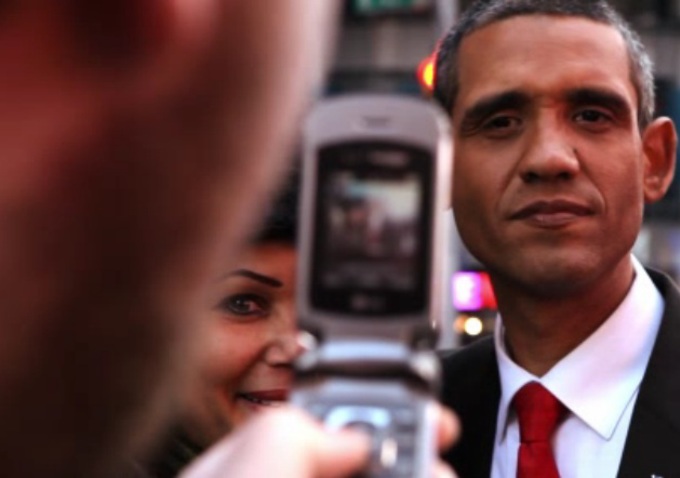
Louis Ortiz is Bronx Obama
Layer #1 is the tale of Louis Ortiz, an unemployed, single, Puerto Rican dad from the Bronx who capitalizes on his uncanny looks the moment Obama’s star rises in the 2008 political race.
He’s a hard worker (out of work by force, not by choice) and a great father (his wife passed away many years ago.) His career move is borne out of despair, not greed, and he gives it all he can, playing Obama in goofy Australian commercials and low-budget hip-hop videos. Though it kills him to do so, he sends his daughter to stay with his parents in Florida, where she can have a more stable life—while he pounds the pavement to pay the bills.
As the real Obama begins his quest for a second term, Ortiz takes it up a notch by hooking up with the Dustin Gold, a volatile “agent” of political impersonators who concocts a clever “dinner and a debate” comedy road show featuring Ortiz and a likeable Mitt Romney impersonator named Mike Cote. (When not impersonating Mitt, Cote installs drywall for a living.) Along with Tim-Watters, an ex-Bill Clinton impersonator who’s gained a few too many pounds since the 90’s, the gang goes on tour, scripts in hand. Armed with these new characters, the film dips into pure comedy; in one instance, the crew gets lost in the bowels of a hotel, trying to make their way to the stage. If this weren’t nonfiction, Spinal Tap could have sued for plagiarism.
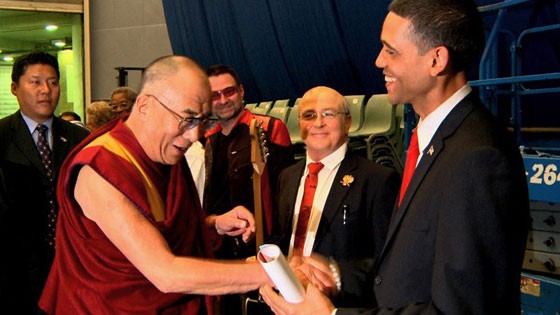
Louis Ortiz meets the Dalai Lama in Bronx Obama
But among the comedy lies another narrative layer: America’s bizarre blending of politics and entertainment. While Ortiz and Cote are amateur entertainers, their professional counterparts are giving America just as much of a show, and the film bounces back and forth between the comedy road trip and actual campaign trail coverage, underscoring the obvious parallel. Even wackier is the fact that Ortiz and Cote’s personal politics actually reflect those of the people they’re impersonating, and we see them arguing armchair politics in hotel rooms and on road trips—a poor man’s version of the real thing, and a microcosm of workingclass America’s own internal rift.
Ortiz isn’t really a political guy but rather a decent, hardworking American trying to support his family and who, as is abundantly clear, loves his daughter more than anything else in life. All the work he puts into toning down his Bronx accent and memorizing dopey one-liners he does not for the glory of performance, but for the paycheck he can bring home. That Ortiz must endure continual humiliation—both from his temperamental boss and from the white, conservative crowds he entertains every night—while he plays the role of a man who symbolizes so much for so many is an irony too thick for words. “Some of these jokes are borderline racist,” he tells us right before performing at a libertarian convention in Vegas. He’s right, but his Obama parody gives the crowd an outlet for all their race-fueled hatred, and the show’s a hit. As we watch Ortiz apply makeup to make his skin appear darker, the historical black-face context is impossible to miss. “We’ve come so far,” Bronx Obama is telling us, “yet nothing has changed.”
The film can be rented or purchased through a number of sites which be found at the film’s official homepage at http://www.bronxobamamovie.com/

Leave a Reply